
Dual Performance Chips
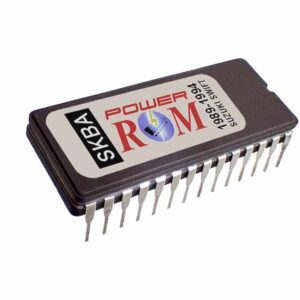
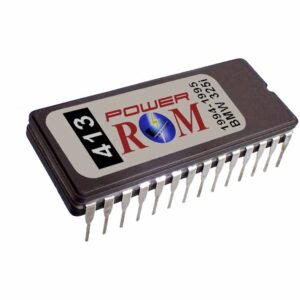
Many performance enthusiasts must have heard or read about dual chips. Dual chips are chips whose memory capacity doubles the memory capacity of the original chip, so two different, same-size programs can be written inside the new chip, and it can be selected between them on the fly, simply by using a small switch.
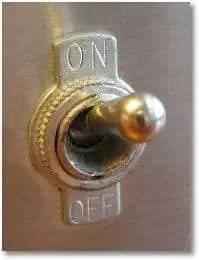
The idea is useful for selecting between the stock program and the performance or fuel economy program. That is, a “Normal” and “Sport” or a “Normal” and “Eco” options switch. Also, if your car doesn’t pass smog tests because of a performance chip you are using, this solution would allow you to use the stock program by selecting it on the flip of a switch. You may use the stock program in the street, when cruising, and when doing the inspection, and switch it to performance for off-road activity.
If the original chip is small enough in memory capacity or the new chip is large enough, there can be installed more “versions” or “power levels”, but a more complex switching would be needed. We will cover here the dual program chip only, using a 27C512 (64KB) EPROM, where the original is a 27C256 EPROM (32KB).
If you don’t have or don’t know how to use or manage the chip-burning equipment, you may ask somebody skilled in this to do the burning part. If using the “Normal” and “Sports” versions, then you would ask the stock program to be burned in the lower memory page of the chip (0000h-7FFFh) and the performance program in the higher memory page (8000h-FFFFh). This is done by attaching one program to the other in that order, making a single binary file, but doubling in memory space.
There are many products out there to do this dual-chip switching. An example is a chip socket with jumpers, averaging between $30 and $80, like the Moates product, which is a very nice one.
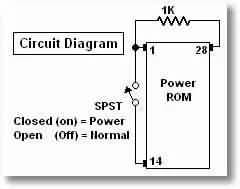
You will just need a 1k-ohm resistor, a small switch, and some thin electrical cable. If you can get a thin shielded 2-conductor wire, the better. That way, you use the two internal conductors of the switching and tie the external shielding to ground. This will avoid the switching wires from picking up electronic noise like an antenna would do, which may lock up the MCU in the ECM, causing the uncomfortable situation of needing to turn the ignition off and starting the car again. Below is the simple schematic:
Automotive Products, Services, and Articles
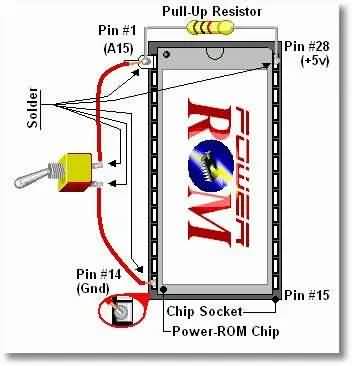
The connection diagram is something like the one below:
Automotive Products, Services, and Articles
Installation
The resistor must be soldered directly to the pins #1 and #28 of the chip. Do this with the chip out of the socket, or you will ruin the socket. Solder must only cover the upper part of the chip leads, or the chip could not be reinserted in the socket, or cause false connections. Then, the switch must be wired to leads #1 (carefully, in the same spot as the resistor) and #14 in the upper part of the chip leads, too. Now the chip can be carefully reinserted in the socket, but pin#1 must be hanging out of the socket, unconnected, nor touching any part of the socket’s metal contacts.
The above is done because pin#1 is used only when programming (writing) the chip, and it is of no use for the ECM (the ECM only reads the chip, it does not write to it), but for some reason, Honda and many other manufacturers wire it directly to the +5V supply of the ECU. This will cause a short circuit if the pin#1 is inserted in the socket and WILL damage the ECU when the switch is flipped to the ground position (Pin#14), which corresponds to the “Normal” mode. All this is prevented by leaving the lead of pin#1 hanging, floating out of the socket.
Special Details
There are two details about this installation;
(1) In some cars, switching on the fly will have no effect. In these cars, for changes to take place, the car must be turned off, the switch flipped, and then the car turned on again. Now changes are available.
This is because in those cars, as soon as turned on, the ROM chip is read and transferred to RAM memory, which is faster. That is called ROM shadowing or ROM masking. When the car is turned off and then on, it is forced to re-read the ROM, and with the switch already flipped, it will read the newly selected program and transfer it to RAM.
(2) In most cases, the cables for the switch must not be longer than 12 inches. That is why we recommend installing it in the ECM body instead of the car dashboard, and in any case of installation, a shielded cable is recommended, and the shielding is connected to ground. Electrical noise can cause the switching of programs to become unstable and turn on the check engine light or might also cause the ECU to act erratically or to lock up.
Summary
The method described above is a precise one and has been tested with no problems. It is offered as an economical option for implementing a simple system like this, but if you don’t have experience or knowledge in electronics or do not feel comfortable doing this, we recommend that you bring it to a trained person who can do it for you. A trained person might charge a small fee, but damaging the ECM while trying on our own can be really expensive.



Where can i buy a chip with two programs for switching? thanx
Please, send a message through the “Contact” section at the page listed below, with details like the model of your car and ecu number, the programs you need, etc. Include whatever you think is relevant.
http://www.otherdeal.com
Regards,
Richard
Would this chip work in a 1995 starlet GT turbo?
No, sorry. We do not have chips for Toyota. I don’t know of any seller that does so far…
That is why piggy backs and programmable engine management systems (EMS) are often used on Toyota models.
Of course, there are very few exceptions, but it will require modifying the ecu in a very costly way.
I regret I can not help.
Rick
would it work on a Plymouth acclame 3.0