My car engine hesitates when I accelerate!
Sometimes when we are cruising in our cars and decide to accelerate either slightly or harder, we experience an annoying hesitation or stalling. Many factors can cause this, but often it’s something we can fix ourselves: a dirty MAF sensor.
You probably know that the MAF sensor senses the amount of air flowing from outside into the engine through the intake hose. The ECM uses this sensor to measure incoming air mass, so it can calculate how much fuel to inject within a minimum-to-maximum range without adversely affecting the target air/fuel ratio for the needed performance (acceleration in this case).
If the MAF’s incoming air calculation is wrong because it is dirty, the ECM will inject fuel based on the incorrect airflow reading. The ECM usually sees lower incoming airflow when the MAF sensor is dirty, even when plenty of air is actually coming in. In turn, the ECM injects less fuel for the supposedly lower airflow to maintain the air-fuel ratio, which ends up too lean. This will produce the hesitation or stalling you are experiencing. In the worst cases, it will include engine knocking.
For more details, you may access the information and ordering webpage at the link below:
You may think you are using a very good air filter, so the MAF sensor can’t be the problem. Still, the bad news is that Airflow sensors (MAF, MAFS, or AFM) get contaminated by microscopic debris that escapes the vehicle’s air filter and accumulates over time on their sensing parts. Micro-particles too small to be stopped by the filter can affect MAF sensor accuracy and, in turn, engine performance.
Another issue is that gases may flow backward from the engine cylinders through the intake valves, all the way back through the intake manifold to the MAF sensor. For example, a backfire in the intake manifold can coat the MAF sensor elements with a thin carbon soot film over time and affect performance.
Modern MAF sensors have two essential functions for detecting the condition of incoming air. First, to detect mass instead of volume, it uses a hot wire. By accurately sensing the current flow through the hot wire needed to maintain a specific temperature, it can calculate the mass of air present based on how quickly the wire loses heat as incoming air dissipates it. It’s simple: the more incoming air by mass, the more current the sensor needs to keep the hot wire at the reference temperature. Air temperature also affects this calculation, which brings us to the second essential function: the IAT (Intake Air Temperature) sensor. Modern MAF sensors integrate the IAT sensor. The cooler the air, the denser it is, and therefore the more oxygen it contains by volume. Other factors like altitude matter (the higher the altitude, the rarer the air, and the less oxygen), but other sensors outside the MAF sensor handle that. That said, you can imagine how important it is to keep the surfaces of these elements inside the MAF sensor clean. An element coated with dust or soot cannot detect anything in the surrounding air.
Interested in the full wiring diagram of the ECU connections of the 2005-2007 Toyota Corolla?
(ALWAYS check your SPAM folder in case that you don't see the download in your inbox.)
Your information is safe with us. We take privacy seriously and DO NOT sell or share your information in any way.
Your data will only be used for sending the requested document(s) and for emailing any related information or material that we might offer in any future. If we do so, you will always be provided with a link for unsubscribing if you desire to do so.
This article describes a simple solution to try. Try this solution before doing any further troubleshooting, as this is a very common issue in fuel-injected cars. The example in this article is based on a 2004-2007 Toyota Corolla MAF sensor. Still, it also applies to many other models, like the Toyota RAV4, or virtually any car equipped with a MAF sensor or flow meter.
Below is a list of symptoms your car may show that could indicate a dirty MAF sensor.
- If the accelerator is slightly depressed while the car is running, and it lags, stalls, or hesitates
- If after completely stopping the car, it stalls when taking off
- Engine power is below the usual level
- Poor fuel economy
- Sometimes the check engine light turns on
- Engine knocking*
*May occur, for example, when going uphill, because of the lean fuel mixture. This is a dangerous situation for the engine at high RPMs.
If the problem is a dirty MAF sensor, the easy solution is to clean it, not replace it, since MAF sensors are expensive and cleaning them is cheap and simple. However, MAF sensors are also delicate electronics. Do the process carefully to avoid damaging the part.
Cleaning the MAF
For this example, you will need a #2 Phillips screwdriver to remove the two screws that hold the MAF sensor in place (different architecture in other makes and models), and a spray can of special MAF sensor cleaning product. This cleaner is designed to clean without harming the MAF’s sensitive internal parts, and it leaves no residue. The brand “CRC” is an excellent option and isn’t expensive. The “Mass Air Flow Sensor Cleaner” is available below:
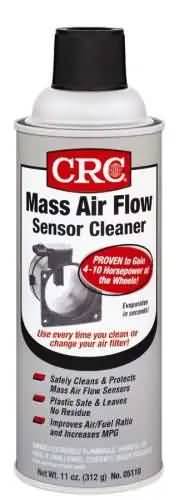
CRC Flowmeter (MAF) cleaner spray
Next, locate the MAF sensor in your Corolla (or any other model you have). In the Corolla, it is very accessible, and you don’t need any mechanical experience to do this. The picture below shows the location of the MAF sensor on 2004, 2005, 2006, and 2007 Corollas (earlier or later models may be in the same area). You will find it in the engine compartment, installed somewhere in the air intake path. In this case, it is behind the vehicle’s battery (driver’s side), attached by two #2 Phillips screws. Remove the screws with a #2 Phillips screwdriver.
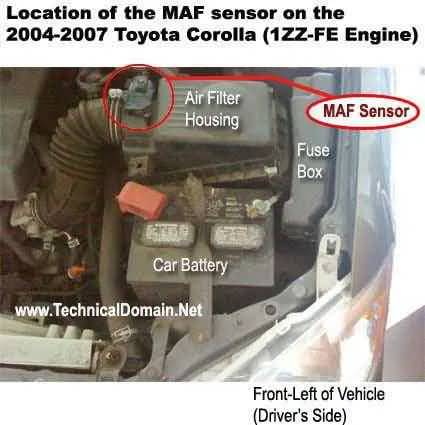
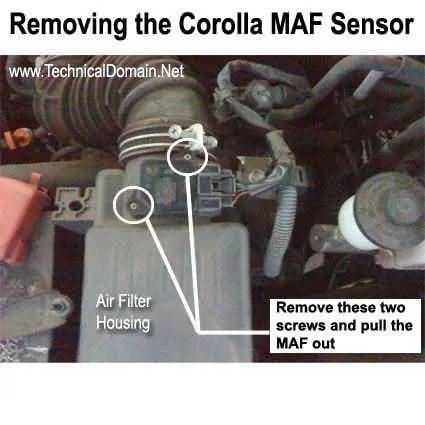
After removing the screws and putting them somewhere safe, pull out the MAF sensor. It may feel slightly stuck, but if both screws are removed, it will come out. Just pull it gently.
The next picture shows the MAF sensor after it has been pulled out. Now disconnect the attached wiring harness by pushing the plastic lock clip in the plug while pulling the plug at the same time. It will easily come out.
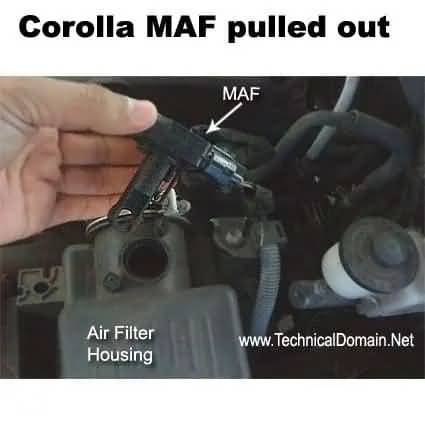
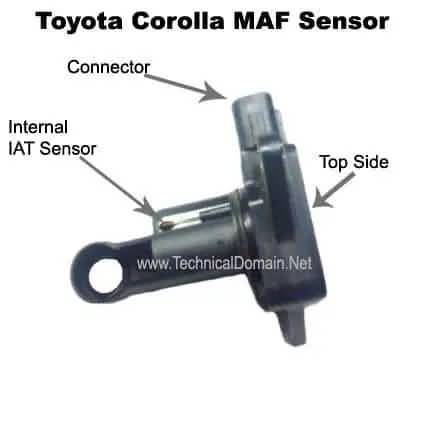
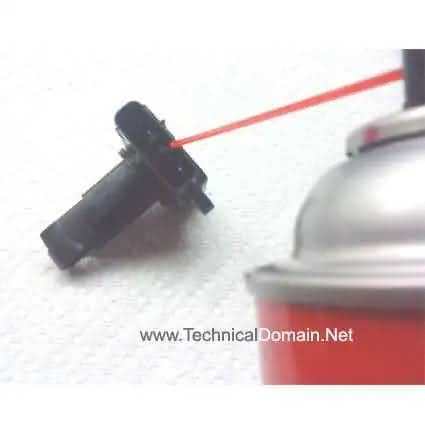
With the MAF sensor already out, place it on a table over a paper towel or cloth and spray the connector harness directly with CRC cleaner to remove debris and dust from the contacts. Just spray it with full force for a couple of seconds. Wear eye protection to prevent spray from bouncing into your eyes. Do this in a well-ventilated area.
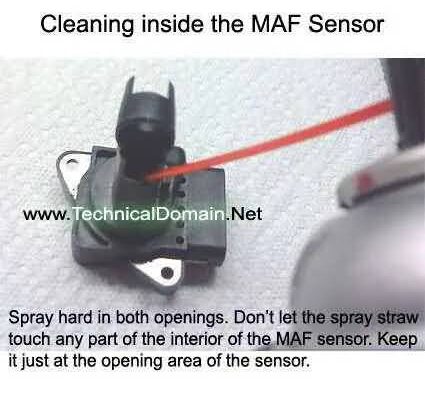
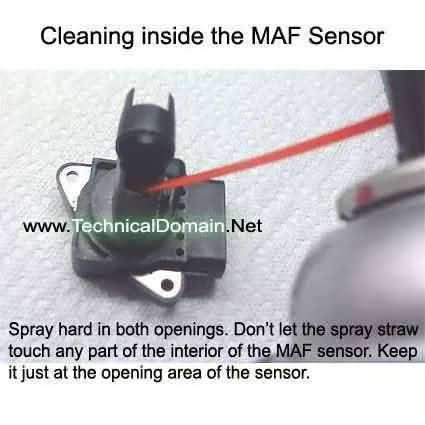
Now, spray full force into the MAF sensor openings for a couple of seconds at each opening. Avoid touching the MAF sensor internals with the spray-can straw while spraying. After spraying, repeat once more, then turn the MAF sensor upside down so excess liquid drips out. Allow enough time for the MAF sensor to be completely dry before reinstalling it in your vehicle. The CRC chemical is designed to dry almost instantly and leave no residue, but spraying for a few seconds over the surface and internals of the MAF sensor will considerably lower the temperature, causing a mist of water condensation from the environmental moisture. That mist will take more time to evaporate than the CRC cleaner’s chemical. A good trick: if you drove your car right before doing this and the engine is still warm, put the MAF sensor on top of the engine’s plastic cover for at least 15 minutes, and the heat will dry it completely.
IMPORTANT! Please only use the chemical (spray) described here or one that was designed for similar purposes, which (1) will not harm polymers (plastics), (2) will not harm electrical connections or electronic components (not acidic or caustic), and (3) most importantly, will not leave any residue when it vaporizes. Chemicals that leave any residue or contain lubricants, like WD-40, for example, may not be used for this specific job. Any residue left inside the MAF sensor will damage it or make it perform worse than before. Remember that this job is about removing contaminants, not replacing them with some other substance 🙂