What is Octane Rating
Have you ever wondered what the Octane Rating of Gasoline is?
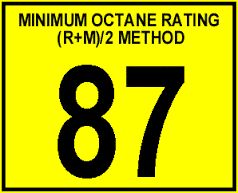
Every time we go to a gas pump to fill our car’s tank, we have the choice of which octane rating to use. More than a preference, your car’s engine has a minimum octane rating required by the manufacturer’s specifications. You can also see a sticker on the gas pump showing the ratings available at that station, and in the USA you will also see the rating calculation method used, like the commonly seen “[R+M]/2” on USA gas pumps. NOTE: USA gas pumps’ rating is also known as the “AKI” rating or “Anti-Knock Index”.
In the USA, ratings are typically 87, 89, 91, and 93 octane. Gas with higher numbers than those is called “Racing Gas,” and (1) it is not commonly seen at standard gas stations, and (2) the price is considerably higher than standard octane-rated gas. But what about it???
Octane rating is a number that defines gasoline’s ability to resist detonation under high-pressure and high-temperature conditions. It does NOT mean that 93 octane gas is way more powerful than 87 octane gas, like Dynamite is way more powerful than gunpowder.
Resistance to detonation is how hard we can push or compress gasoline in our engines (taking temperature into account) before it detonates without the spark plug firing. When gasoline ignites without a spark, it causes what is called a detonation. It is also known as “pre-ignition”, “knocking”, or “pinging”. The last one is called “pinging” because of the metallic pinging noise it makes. The same goes for “knocking.”
Your car’s engine is an internal combustion engine, and the “combustion” we want is a controlled and gradual explosion or deflagration, not a detonation, which is way faster and more powerful. Detonations at low engine speeds and power will sound like pinging and may not damage the engine for short periods, but over time they can cause the engine to fail if they persist. At high engine speeds and power, detonations may blow a piston or the engine itself. Detonations provide no usable power because they occur too fast and deliver a shock to the piston instead of a gradual push. It is like hammering your car’s engine.
The higher the octane rating, the more compression and temperature it resists, leading to fewer or no detonations. Racing and muscle cars often produce high compression and elevated engine temperatures, which is why it is normal to use very high-octane gas in such vehicles.
Why Do Detonations Occur?
It is not convenient that gasoline fires before it is meant to. A car engine is a complex machine with specific timing and synchronization of its moving parts, and physical damage may occur if something moves when it shouldn’t. Beyond physical damage, the engine will also have many performance problems.
When the engine shaft is rotating, the TDC, or “Top Dead Center”, is the exact point where the piston stops moving up to start moving down. During the compression stroke of that piston, when it is going up, several rotational degrees before reaching TDC, if the air/fuel mixture suddenly ignites because of high pressure and high heat, that scenario produces a detonation because the piston motion is still pushing upward, driven by inertia and by the wheels and transmission movement, and the sudden ignition of the mixture tries at the same time to push it down. The pressure rises to an unimaginably high level, creating the detonation. The detonation is so fast that it produces no usable mechanical force or push. Again, like hammering the engine cylinder, but across all areas at the same time. This mostly happens with lower-octane gas. Higher-octane gas prevents this with its anti-detonation property. Detonations at high engine speeds can cause catastrophic engine damage.
Detonations can happen from various situations or engine malfunctions, but there are a few that are common:
-Too low-octane fuel is being used
-Ignition timing is way too advanced
-Air/Fuel mixture is too lean
Modern cars have knock sensors programmed to “hear” and distinguish detonation sounds from other engine noise. When the sensor detects a knock, the engine control module runs a routine programmed into its memory to retard ignition timing by several degrees to stop detonations.
Octane Rating Calculation Methods
Various calculation methods exist: RON, MON, PON, or AKI.
RON: (Research Octane Number). Most common fuel used in Europe, Australia, and some other Countries. It is determined by measuring fuel behavior in a variable-compression engine. Results are compared with other iso-octane fuels, meaning other fuel types with an equal number of similar octane molecules, but not the same organic compound.
MON: (Motor Octane Number). Determined also with a variable compression engine, but with the fuel already preheated, variable ignition timing, and higher RPMs than the RON method. This method is more precise in determining fuel behavior on a loaded engine.
PON or AKI: (Pump Octane Rating or Anti-Knock Index): This method is used in the USA and Canada and is expressed as [R+M]/2, meaning the RON result plus the MON result divided by 2. In other words, it is the average of the two methods above.
Equivalency
Because RON is always 4 to 5 points higher than its equivalent to PON or AKI, the number conversion between USA and Europe octane ratings will approximately be as follows:
USA (PON or AKI) = Europe (RON)
87 Octane = 91 Octane
89 Octane = 93 Octane
91 Octane = 95 Octane
93 Octane = 98 Octane